
 UAE
UAE
 India — you are here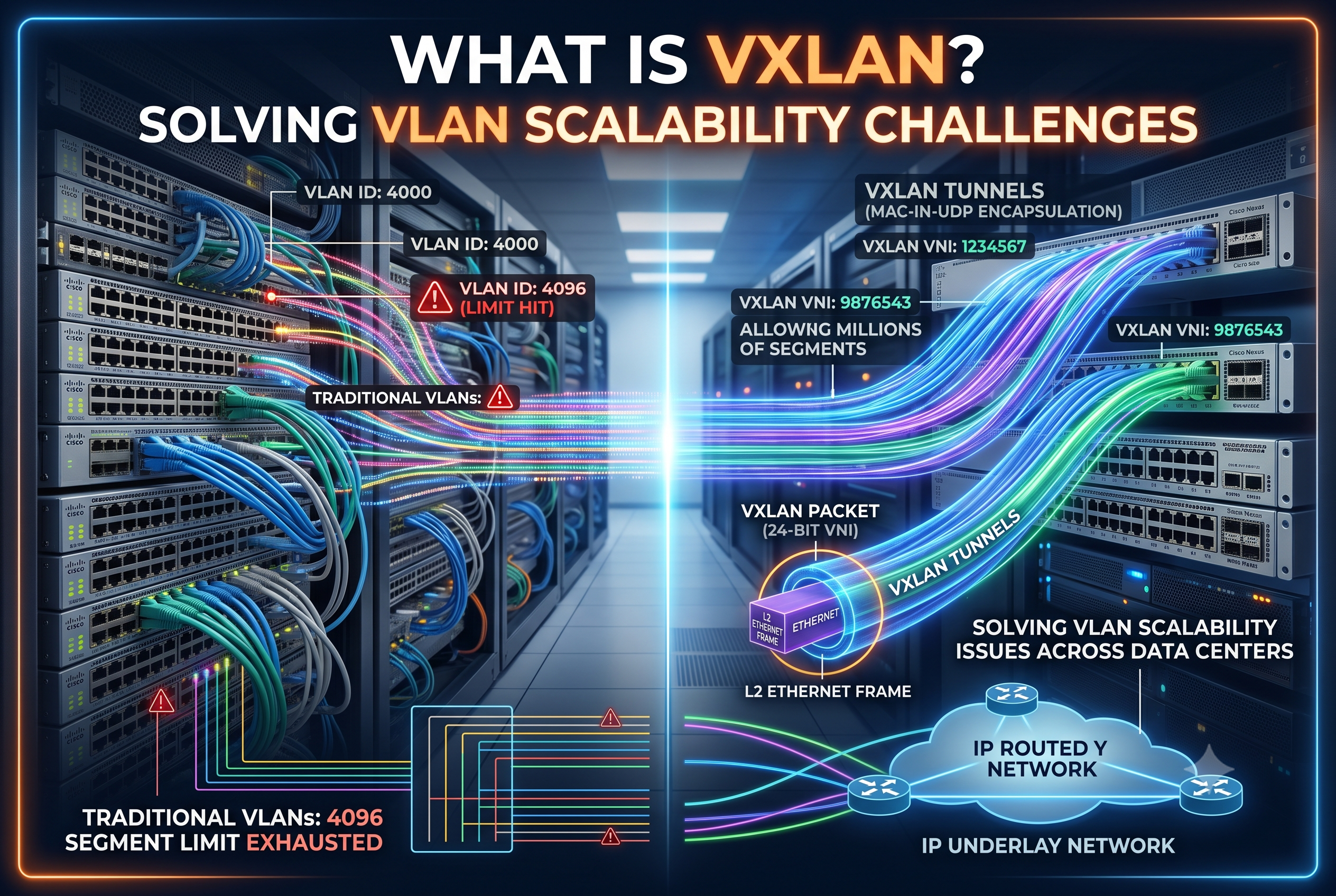
Ask any network engineer in India what keeps them up at night, and VLAN limitations come up sooner or later. Networks that once ran fine on a handful of VLANs are now straining under cloud migrations and virtualised workloads that keep multiplying.
This is where VXLAN in networking steps in. Whether you manage infrastructure for a growing business or are building your own skills, understanding VXLAN networking is quickly becoming a baseline expectation. This blog covers what VXLAN is, why VLANs struggle to scale, how VXLAN architecture works, and why it matters for a networking career.
What Is VXLAN in Networking?
VXLAN stands for Virtual Extensible LAN, a network virtualisation technology that creates logically isolated networks on top of an existing physical network, without being limited by that network’s boundaries.
Picture it as a way to stretch a Layer 2 network across Layer 3 infrastructure. Ethernet frames are encapsulated in UDP packets and sent across an IP network, so devices in different racks or even different data centres can appear to share a single local network. In practical terms, VXLAN is what made large-scale, cloud-ready, multi-tenant networking possible, without forcing teams to redesign the physical network every time the business grows.
Why Do Traditional VLANs Struggle at Scale?
VLANs worked fine for a simpler era of networking, but a few structural limits quickly become apparent as a network grows.
- VLAN ID ceiling. Tagging supports close to 4,000 usable IDs, which can be quickly exhausted in a data centre or large enterprise.
- Spanning Tree constraints. VLANs, based on Layer 2 protocols never designed for large, flat networks, lead to underused links and slower recovery during failures.
- Weak mobility. VLANs are tied to physical Layer 2 boundaries, so extending one across sites usually means fragile, manual workarounds.
- Multi-tenant pressure. Cloud providers and large enterprises need to isolate thousands of customers on shared infrastructure, a job VLANs were never built to handle.
These affect uptime, security, and how fast a business can scale- the exact problem VXLAN networking was built to solve.
How Does VXLAN Work?
The short answer is encapsulation. VXLAN wraps an Ethernet frame in a UDP packet that includes a VXLAN header and sends the frame over a standard IP network, regardless of the underlying physical topology. This happens at devices called VXLAN Tunnel Endpoints, or VTEPs, which encapsulate the frame, forward it to the destination VTEP over IP, and unwrap it before delivering it locally.
Here is the part that fixes the scalability problem. Every VXLAN segment carries a VXLAN Network Identifier, known as VNI. Unlike the 12-bit VLAN ID, the VNI uses 24 bits, increasing the number of possible segments from roughly 4,000 to over 16 million.
Many deployments also pair VXLAN with EVPN, a configuration known as VXLAN EVPN, which serves as the control plane. VXLAN moves the data, while VXLAN EVPN manages how devices discover each other and how routes get distributed.
VXLAN vs VLAN: What Is the Difference?
The VXLAN vs VLAN comparison confuses learners because both segment networks. The real difference lies in scale and how each operates underneath.
| Aspect | VLAN | VXLAN |
| Identifier size | 12 bits, around 4,000 IDs | 24-bit, over 16 million IDs |
| Network layer | Layer 2 only | Layer 2 over Layer 3 overlay |
| Scalability | Breaks down at large scale | Built for cloud-scale networks |
| Mobility across sites | Limited to one Layer 2 domain | Extends across data centres over IP |
| Best suited for | Small to mid-sized LANs | Data centres, cloud, multi-tenant setups |
VLAN still has a place in smaller networks. VXLAN is what enterprises reach for once they outgrow their current options.
How VXLAN Solves the VLAN Scalability Problem
Once VXLAN architecture makes sense, the fix for VLAN scalability becomes clear. Moving segmentation into a 24-bit VNI removes the hard ceiling that kept tripping up growing networks, and separating the logical network from the physical one means rigid Layer 2 boundaries no longer box in engineers. Connectivity can span racks, floors, or separate locations without the unreliable workarounds that a pure VLAN setup used to require.
Key Benefits of VXLAN
The VXLAN benefits go beyond just raising a number:
- Massive scalability through the 24-bit VNI
- Stronger multi-tenancy support for cloud and shared infrastructure
- Better workload mobility, since virtual machines move without losing identity
- Efficient use of existing IP infrastructure
- A solid base for automation when paired with VXLAN EVPN
These translate into networks that scale without constant redesign, wherever in India an organisation happens to be growing.
Why Should Network Engineers Learn VXLAN?
The networking landscape in India has changed rapidly, and today, data centres are growing in every corner, coastal and non-coastal, and in all climate and seasonal conditions, and cloud is gaining popularity in every corner. Skills such as VXLAN architecture and VXLAN EVPN are now expected in roles tied to data centre and cloud infrastructure, with employers seeking engineers who understand overlay networking, not just traditional switching and routing.
Chasing every available certification is not the smartest strategy, though. Certifications matter most when a specific employer or role actually asks for them. What builds a durable career is hands-on understanding of how networks behave under real-world conditions, and that is where real-time training makes the difference. Working through live scenarios and configuring overlays, tunnels, and control planes builds confidence no certificate alone can replace. The smarter move is consistent upskilling, not collecting credentials that may not match what employers actually want.
Build Real Networking Skills with NG Networks
VXLAN is no longer a niche topic reserved for specialists. It is becoming core knowledge for anyone serious about data centres and enterprise networking, and understanding how it solves VLAN scalability puts you ahead of engineers who still think purely in Layer 2 terms.
At NG Networks, we focus on building engineers through real-time training that mirrors how networks behave in live environments across India. Connect with NG Networks to strengthen your practical foundation and take the next step in your upskilling journey.